Enrichment ideas for dogs
By Mila · Last reviewed October 2026
A walk tires the legs. Sniffing, searching and working out a puzzle tire the brain, and many dogs settle better at home once that side gets some use too. These 15 enrichment ideas for dogs are grouped by the kind of work they give your dog. Most cost nothing and take ten minutes. Pick two from different groups and rotate them through the week.
What dog enrichment means
Enrichment means giving your dog regular chances to do dog things: sniff, forage, chew, chase and solve small problems. A dog that gets to do them often has less reason to invent its own projects. Think of the trash can, or the corner of the rug. Fitting this around a working day is a separate question. Our guide on how to keep a dog busy while you work from home covers the schedule. This page is the menu of ideas.
Sniffing enrichment ideas for dogs
A dog’s nose is its strongest sense. Sniffing games are the easiest place to start.
- Scatter feeding. Throw part of a meal across a clean lawn or a hard floor and let your dog hunt it down piece by piece.
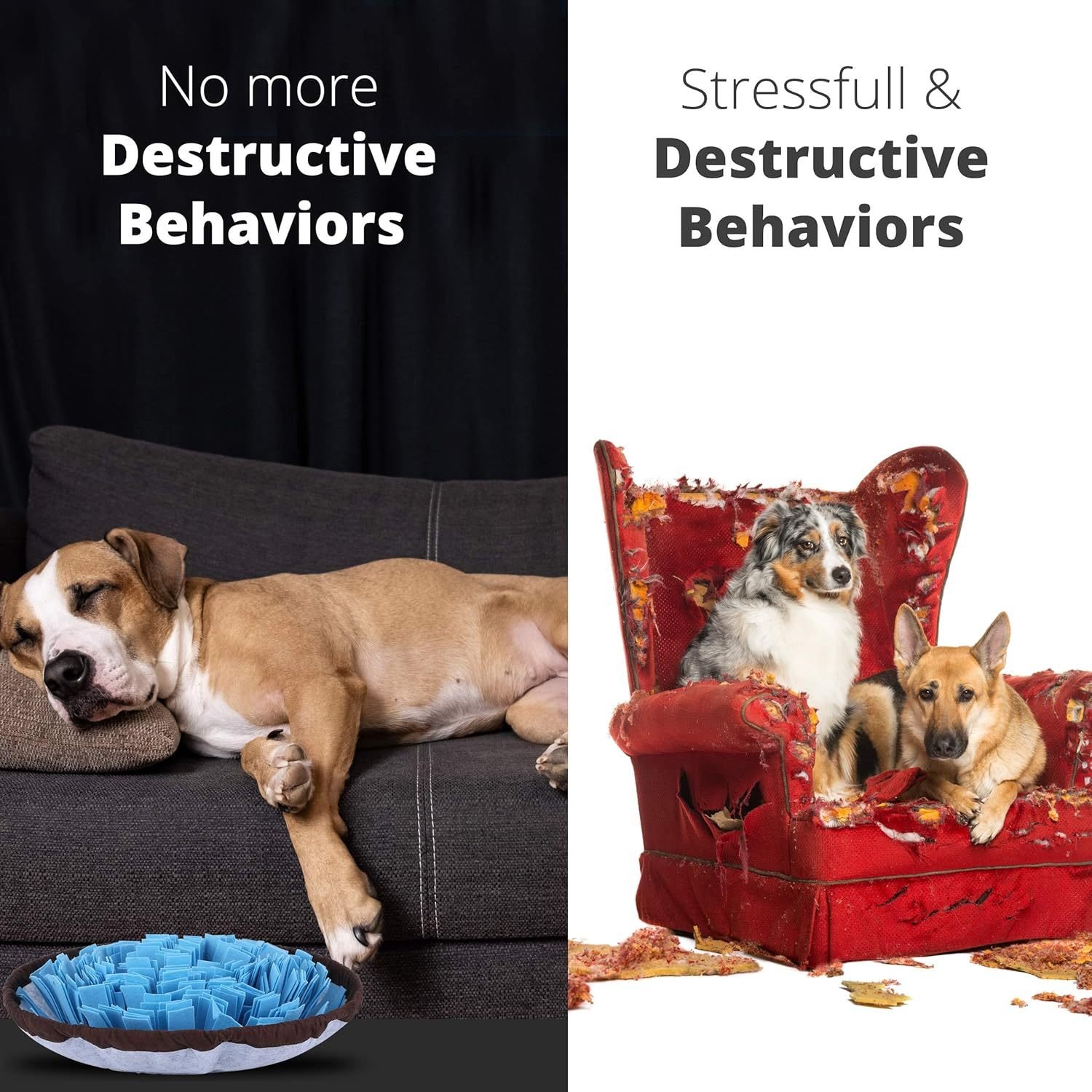
- Snuffle mat. Hide kibble in fabric flaps so your dog has to nose it out. The Adjustable Snuffle Mat draws in to a bowl shape for small dogs and opens flat for large ones.
- Find it. Show your dog a treat, put it behind a chair leg in plain sight and say “find it”. Hide the next one a little further away. Build up to hiding treats in another room.
- Sniff walk. Give your dog ten minutes on a walk to choose the route and the pace. Stop when they stop. A new street is more interesting than a faster loop of the usual one.
Food puzzles and boredom busters
Food puzzles turn a meal into a job. Use part of your dog’s normal daily food, so the games do not add extra calories.
- Slow feeder at mealtimes. Raised ridges spread the kibble out and make your dog work around the pattern. The Slow Feeder Dog Bowl does this twice a day with no extra effort from you.
- Layered treat puzzle. The Hamburger Snuffle Puzzle has fleece layers that come apart. Tuck treats between them and let your dog pull the burger apart to find them.
- Muffin tin game. Drop a piece of kibble into each cup of a muffin tin and cover the cups with tennis balls. Your dog has to move each ball to get the food.
- Cardboard unwrap. Fold kibble inside a toilet paper tube or a small box stuffed with paper. Stay with your dog and pick up the cardboard before it gets eaten.
- Frozen lick toy. Spread wet food from your dog’s usual diet into a rubber toy or lick mat and freeze it. Licking is slow, steady work, and a frozen filling lasts longer.
Chewing
- A chew that fits your dog. Chewing is calming work for many dogs. Offer a chew sized for your dog’s mouth, stay nearby, and take it away once it gets small enough to swallow.
Play and toys
- Toy rotation. Keep two or three toys out and put the rest in a closet. Swap them every few days. A toy that disappeared for a week comes back new.
- Tug with rules. Start the game on a cue, pause it on a cue, and let your dog win some rounds. Tug uses a lot of energy in a few minutes.
- Hallway fetch. On a rainy day, a soft toy and a long corridor are enough. The Corduroy Squeaky Donkey Toy is light enough to throw indoors.
Training and new places
- Five-minute trick sessions. Teach something small: touch your hand, spin, give a paw. Short sessions with treats from the daily ration work better than one long lesson.
- New surfaces and places. Walk on sand, gravel, a low wall or a different park. Let your dog explore at its own pace and move away if it seems worried.
How to build a dog enrichment routine
Most dogs do well with one sniffing game and one food game a day, on top of their walks. Ten to fifteen minutes each is a good starting point. Watch your dog afterward. A dog that lies down and sleeps got the right amount.
- Start easy. Put the food where your dog can see it, then hide it deeper as they learn the game.
- Supervise fabric and cardboard. Snuffle mats and plush puzzles are for sniffing, not chewing. Put them away when the food is gone.
- Rotate. The same game every day gets solved fast. Change the game, the room or the hiding spots.
- Know the limits. Enrichment helps a bored dog. It does not fix separation distress, fear or aggression. Talk to your vet or a qualified behaviorist if you see those.
Questions about dog enrichment
What counts as enrichment for a dog?
Anything that lets your dog use its natural skills: sniffing, foraging, chewing, chasing or solving a problem. Scatter feeding, a snuffle mat, a frozen lick toy, a new walking route and a short trick session all count. The best enrichment ideas for dogs match what your own dog enjoys doing most.
How much mental stimulation does a dog need each day?
There is no fixed amount, and it varies by age, breed and energy. A good starting point is one or two sessions of ten to fifteen minutes a day, on top of walks. If your dog settles and rests afterward, that is about right. If they still pace or chew things, add a session.
Are snuffle mats good enrichment for dogs?
Yes, with supervision. A snuffle mat makes your dog find each piece of food by scent, which slows eating and gives the nose real work. Use dry food and start with pieces on top. Put the mat away once the food is gone, so it does not become a chew toy.
What are easy dog boredom busters with no toys?
Scatter part of a meal on the lawn, play “find it” with treats around the house, or fold kibble into a toilet paper tube. A ten-minute sniff walk on a new street also works. None of these need anything you have to buy.
Can enrichment stop a bored dog chewing furniture?
It often helps when the chewing comes from boredom. Give your dog a better job, like a food puzzle or a suitable chew, at the times the chewing usually happens. Make sure walks and meals come first. If the chewing happens only when you leave, talk to your vet or a behaviorist.
The gear we stock for this is on our Anxiety & Enrichment page.
About the author
Mila is a mother of two and a dog owner in Lisbon, Portugal. She looks for things that make family life with a dog more comfortable. She believes in quality products that fit the dog and the home well.